
Home
Welcome on the website of the Graduate Gender Programme of Utrecht University. This website will help you navigate through the information provided on the Utrecht University websites. If you still have any questions please contact us.

Frames of Palestine (part 3) – Film Screenings
 The GGeP is continuing with the third installment of their series of film screenings entitled Frames of Palestine. The first screening of part 3, which will be the film Gaza Surf Club (2016) by Philip Gnadt & Mickey Yamine, is taking place Wednesday March 13th, 17:15-19:00h at Kromme Nieuwegracht 80, room 006. Find more information about the upcoming screenings here.
Frames of Palestine (part 2) – Film Screenings
 After the Christmas break, the GGeP is continuing their series of film screenings entitled Frames of Palestine. The first screening, which will be the film Photo Booth (2022) by John Greyson, is taking place Wednesday January 24th, 16:30-19:00 at Janskerkhof 2-3 (Room 013). Find more information about the upcoming screenings here.
Frames of Palestine – Film Screenings & National Walk-Out November 29
 GGeP is organising a film screening series entitled Frames of Palestine. The first screening will take place Wednesday November 29th, 17:15-19:00 at Drift 25 (room 1.02). Find more information about the upcoming screenings here.
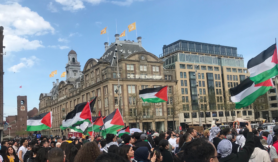
There will also be a national walk-out on November 29th, 12:00-13:00 happening at multiple Dutch universities, including Utrecht, which coincides with the international day of solidarity with the Palestinian People. The location for the Walk-out in Utrecht will be the Bestuursgebouw (Heidelberglaan 8).
Moreover, students and employees of Utrecht University have written an open letter to the Executive Board of Utrecht University urging them to reconsider their neutral stance in the ongoing genocide happening in Gaza. You can sign the open letter by clicking on this link.
Utrecht Gender Studies Statement – Palestine Solidarity Statement, 2023
 The way before us is quite clearly marked.
We are either to fight for justice, truth,
and the right to honest criticism, or we should
quite simply give up the title of the intellectual.
(Edward Said, 1989)
We as the Graduate Gender Programme endorse the Dutch Scholars for Palestine’s statement, which can be read and signed here.
As scholars, we also stand with the voices expressed in the Birzeit university union’s statement and maintain our solidarity with the Palestinian people.
Rabeea Ahmad receives the Hélène Phoa Gender Studies Research Thesis Prize 2022
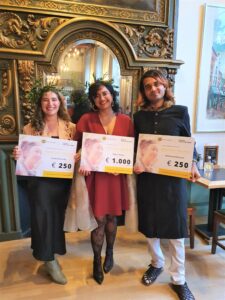 The year 2022 marks the third awarding of the Hélène Phoa Gender Studies Research Thesis Prize. The winner is Rabeea Ahmad with her thesis titled The Transparency/Opacity Conundrum: Locating Dutch Deportation Regimes at Schiphol Detention Center. The prize was awarded during the diploma Graduation Ceremony of the Research Master Gender Studies on October 31, 2022. The jury enjoyed reading all submitted theses, as they offer an exciting view of what constitutes Gender Studies for a new generation. Although the jury encountered a variety of topics and approaches all submitted work had one thing in common: all authors were committed to knowledge production that contributes to social justice and inclusive diversity. The jury also warmly congratulates the two honorable mentions, Sophia Pekowsky Postpartum as Portal: Reimagining Western Conceptions of the Human Through Linocut Printmaking Workshops on Postpartum and Motherhood and Muhammad Khurram Queerness, Illness: The Psychosomatic Materialities of Pakistanis. See here for the complete interview with this year’s winner.
GEMMA: Erasmus Mundus Master’s Degree in Women’s Studies
Erasmus Mundus Master’s Degree in Women’s and Gender Studies (GEMMA), is a two-year postgraduate interdisciplinary study programme that provides high quality education and professional competencies for personnel working or intending to work in the areas of Women’s Studies, Gender Studies and Equal Opportunities across Europe and beyond. Students benefit from international mobility as they study at two different European universities and obtain a double diploma from the Home and Mobility institutions.
On the occasion of International Women’s Day 2019, the GEMMA Master has been included among the ten Erasmus+ projects that have contributed the most to gender equity and empowerment of women. See here
Utrecht Gender Studies statement – Palestine Solidarity Statement, 2021
The Graduate Gender Programme (GGeP) at Utrecht University together with the Netherlands Research School of Gender Studies (NOG) condemn the brutal Israeli assaults against the Palestinians and stand in solidarity with the Palestinian people who are rising up against seven decades of Israeli settler colonial violence. Read our statement here.
Utrecht Gender Studies statement #blacklivesmatter, 2020
 These are momentous times. After weeks of shut down and Covid-19 related anxieties, the world has erupted in mass protests in support of #blacklivesmatter and anti-racist struggles. The Graduate Gender Programme (GGeP) at Utrecht University together with the Netherlands Research School of Gender Studies (NOG) stands in solidarity with the growing global protests and the work that activist groups and organisations everywhere undertake in order to fight structural racism, white supremacy and the continued colonial order. Read our statement here.
GEMMA student Patrick Zaki free, 2023
For more information, see here.
UU Graduate Gender Programme exhibitions 2019:
Exhibition: Footnotes on Equality – in collaboration with Casco Art Institute Utrecht.
Exhibition by MOED: What is left unseen – in collaboration with Centraal Museum Utrecht and the research team of MOED: Museum of Equality and Difference
Platform Gender, Diversity and Social Justice, UU
The Platform Gender, Diversity and Social Justice at Utrecht University provides a demand-driven platform that focuses on analyzing and solving gender, diversity and social justice issues as put forward by our societal partners, as well as to develop strategies for implementing diversity in order to achieve societal inclusion and change. As such, it provides a meeting ground for both researchers and stakeholders, to exchange and enhance their expertise across disciplines, to share and develop best practices and to put possible solutions to the test with a view to truly contributing to the empowerment of under-represented groups in society and to combating stereotyping. The platform is part of research expertise area Institutions for Open Societies.
Platform (In)equality, UU
The Platform (In)equality at Utrecht University focus on the way inequality is affected by different institutions: capital & property relations, divisions of wealth, families, division of care, educational & training traditions, cultural institutions, welfare state arrangements, tax regimes, borders and other international legal structures. Institutions can also affect citizens’ attitudes towards the permissibility of inequalities, for example the rise of meritocratic ideology. The platform is part of research expertise area Institutions for Open Societies.
Equality, Diversity and Inclusion at Utrecht University
Utrecht University stimulates diversity and inclusion within education, research and the organisation. A diverse community of students and teachers contributes to an inspiring and challenging learning environment. In addition, this is a good preparation for working in a pluriform society. Diversity enriches the academic debate and contributes to an intensive cooperation and exchange with social organisations. Utrecht University considers it important to contribute to bridging opposites and creating equal opportunities for all. More information here
Doing Gender in Media, Art and Culture – A Comprehensive Guide to Gender Studies (Routledge 2017)
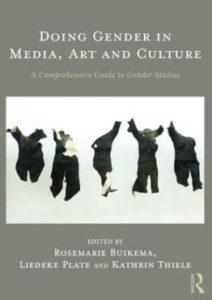 Doing Gender in Media, Art and Culture – edited by Rosemarie Buikema, Liedeke Plate and Kathrin Thiele – is an introductory text for students specialising in gender studies. The truly interdisciplinary and intergenerational approach bridges the gap between humanities and the social sciences, and it showcases the academic and social context in which gender studies has evolved. Complex contemporary phenomena such as globalisation, neo-liberalism and ‘fundamentalism’ are addressed that stir up new questions relevant to the study of culture. This vibrant and wide-ranging collection of essays is essential reading for anyone in need of an accessible but sophisticated guide to the very latest issues and concepts within gender studies. For more info read here.
The German version Doing Gender in Medien-, Kunst- und Kulturwissenschaften, edited by Rosemarie Buikema and Kathrin Thiele was published in 2017 by LitVerlag. For more info read here.
Revolts in Cultural Critique – Rosemarie Buikema (Rowman & Littlefield 2020)

Rosemarie Buikema’s new monograph Revolts in Cultural Critique has been released as part of the New Critical Humanities series, published by Rowman & Littlefield in 2020.
The book is centered around the relationship between art and political transformation. From Charlotte Brontë and Virginia Woolf, to Marlene van Niekerk and William Kentridge, artists and intellectuals have tried to address the question: How to deal with the legacy of exclusion and oppression? Via substantive works of art, this book examines some of the answers that have emerged to this question, to show how art can put into motion something new and how it can transform social and cultural relations in a sustainable way. In this way, art can function as an effective form of cultural critique.
Contribution to publication Beperkt Zicht from Women Inc.
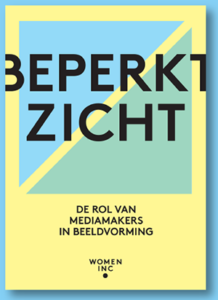 Women are less common in media than men. Research from the Commissioner of Media shows that between 2010 and 2015 their participation in TV-shows from public broadcasting has even decreased. Commissioned by Women Inc. the UU Graduate Gender Program together with Atria dove into the current state of affairs regarding the representation of women: how often do they appear in the media, in what role and are there differences between several media (television, radio, newspapers, online newssources, social media)? The publication Beperkt Zicht (only available in Dutch) can be found here.